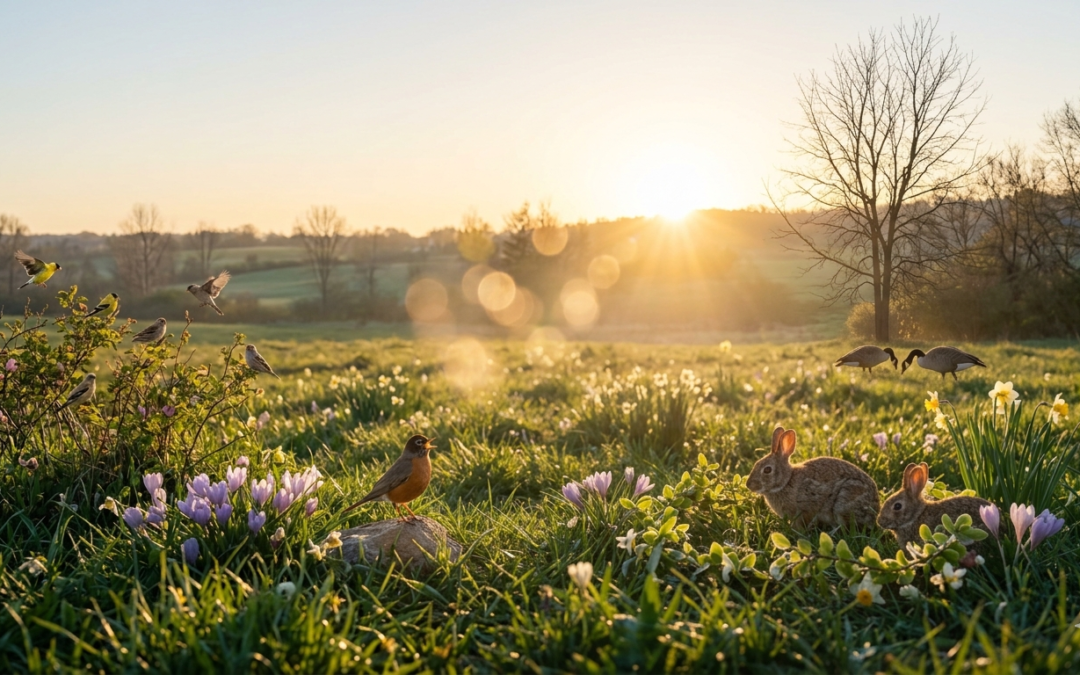
Happy Ostara (Easter, Pascha, Passover …)!
You say Easter, I say Ostara.
You say Passover, I say Pascha.
But ‘And a Happy Vernal Equinox to you as well’? I can’t imagine anyone saying that.
‘Easter’ is upon us, which gives me an opportunity to research and share what I find as I go down ‘the rabbit holes’.
More than ever, we need to embrace the virtues of spring, rebirth and renewal.
Let’s dive in and enjoy the return of the spring!
Anthropomorphic / Visual Representation of Easter
Spring Celebrations Around the World
The roots run deep with this one. Easter and it origins are on the same level as Christmas (which I’ve covered in great detail). If there is a mythological goddess related to Easter, she’s played her hand well by letting Christianity mimic her importance and permanence in the minds of most folks around the world.
For many, the name says it all: a time of the year (in the northern hemisphere) when the sun ‘visits’ us more and more, rising from the East earlier each day, every day until the summer equinox.
Fertility reigns supreme, hence the very busy bunny being a symbol of most lawn-hunt rituals and chocolate shapes. Flowers, pollination, sugar, bonnets, vivid pastel colours pouring forth, like a rainbow from the rising sun.
Ancient European Origins
Many ancient cultures centered their celebrations around the vernal equinox, when day and night are equal. This astronomical moment symbolized balance and renewal.
In ancient Britain, sites like Stonehenge align with solar events, including the equinox.
For many early Europeans, this was the true start of the year—when survival through winter gave way to growth.
There are thousands of other stone monoliths and other sites scattered across Europe that align – usually perfectly – with different phases of the calendar and the Spring Equinox is no different.
Greek Myth – Persephone & Demeter
In ancient Greece, like many other places in the world, mythologies helped explain why things in the world occurred.
The Abduction of Persephone by Hades was used to explain why the seasons changed.
Basically, Hades was a dick and not too bright. He kidnapped the child – Persephone – of one of the most powerful goddesses – Demeter.
For those of you who are rusty on your Greek myth, Demeter = food.
Persephone was tricked into staying, so Demeter held back on letting crops grow. Without harvests, humans would starve and would now longer pay homage to the other gods, so a negotiation took place.
It was agreed that Persephone would stay in Hades’ domain for six months of the year. During that time, Demeter said ‘f&ck you’ to the growing cycle. When Persephone returned, all was good and abundant. The return marked the beginning of spring.
The Jewish Story: Passover

When I was a kid, my family would travel to Guelph and Elora for Easter to visit with my Mom’s relatives. They would usually hang out upstairs and talk about politics and the different gripes of the day. Nothing has changed with family conversation around the table, right?
I found myself glued in front of the set most of the weekend, soaking up epic films like “The Ten Commandments” with Charlton Heston, filmed by the legendary Cecil B. DeMille. Yul Brenner telling Moses to basically Go F&ck Himself and get back to work making bricks with all the other Jewish slaves.
Moses doesn’t take dissing from any Pharoah, let alone Ramses, so he consults with the omnipotent one and hatches a plan to liberate the Jewish slaves from Egypt.
Three or four hours later, we get the most intense graphic effects seen to that point – remember, it was made in the 1950s – and I was officially sworn in year after year.
Occasionally, I also got to watch Ben Hur – ramming speed! – and a few other Easter specials.
Okay .. that’s a pretty lame, goyish take on the incredibly important event known as Passover, so I do apologize for being such a heathen.
The symbolic importance is the profound message with Passover. Yes, it marks the early days of spring and the liberation of the Jews from Egypt’s bondage, but I would dare to also suggest that Passover could be vaguely related to the number of deaths that might have resulted from starvation after long, hard winters. The symbolic passing of the youngest ones feels like a transformative moment of taking tragic circumstances and creating rituals and meaning out of otherwise senseless death.
Overall, it’s a beautiful story that connects the living with their history and belief structure.
The Christian Story: Resurrection
In Christian tradition, it’s the time between the crucifixion of Christ to the point where he is resurrected.
The crucifixion was a barbaric method of torture used by the Romans, especially when dissidents and troublemakers were involved. I think if you were to try to convince me to convert to the Christian doctrine, start with talking about what a badass Jesus was and how the Romans persecuted him for his wisdom and ability to stir things up.
Three days after Christ died, people tell of him coming back to life. Not in a Walking Dead kind of way, but in a crucially important way to connect the day-to-day act of living to understanding that (if you’re a believer) there’s an afterlife. Unfortunately, it also sets the path for believing that the material world is just that, which could be argued is the DNA for the shabby way that we treat the planet.
Three days is also the amount of time before most families go completely bonkers after spending too much time together. Good Friday devolves into not-so-good-Monday … I mean Easter Monday, when everyone’s okay with leaving early and heading home to get themselves busy with spring cleaning and yard sales.
A nice layperson’s version of the Christ Story with Easter can be found here.
Iran & Persian Traditions
Sadly, Iranians probably aren’t celebrating much of anything these days but I’m hopeful that one day they’ll enjoy renewal and rebirth. Ideally, sooner rather than later.
Traditionally speaking, the Persian people celebrate Nowruz which aligns exactly with the spring equinox.
Key themes include:
- Renewal of nature and the soul
- Cleaning the home (spring cleaning originates here too)
- Setting a symbolic table (Haft-Seen) with items representing life, growth, and prosperity
It’s one of the clearest living examples of ancient spring celebration untouched by Easter traditions.
Germanic Origins
Here’s some context just in case you’re not familiar with the history involved:
Ostara, otherwise known as Ēostre, is the Germanic goddess of spring and dawn. On the old Germanic calendar, the equivalent month to April was called “Ōstarmānod” – or Easter-month.
The evidence for Ostara as an actual goddess people worshipped is sketchy. We can pin her down in the writings of 8th century monk Venerable Bede, who reported that pagan Anglo-Saxons in medieval Northumbria held festivals in Ostara’s honour during the month of Eostremonath (April). However, some have speculated that he was making this up (or at least embellishing the truth).
As a holiday, Easter predates Christianity and was originally the name for the spring Equinox. Of course, now the holiday focuses on Jesus’ resurrection story – but many Germanic Easter customs survive. For example, we still paint Easter eggs with bright colours, a tradition which may be linked to chickens’ return to laying after the long eggless winter months.
Whether Ostara was worshipped as a goddess or not, by the 19th century she had become part of German mythology. She was described in literature and added in to paintings.
Piecing together the legends and stories of the emerging German nation, Jacob Grimm wrote in his 1835 Teutonic Mythology: “Ostara, Eástre seems therefore to have been the divinity of the radiant dawn, of upspringing light, a spectacle that brings joy and blessing, whose meaning could be easily adapted by the resurrection-day of the Christian’s God.”
He dismissed the idea that Bede could have invented Ostara, writing of these ancient Teutonic goddesses: “there is nothing improbable in them, nay the first of them is justified by clear traces in the vocabularies of Germanic tribes.”
Grimm also wrote that the white maiden of Osterrode was said to appear with a bunch of keys on Easter morning, when she would stride to the brook to collect water – because water drawn on Easter morning is holy and healing.
A liberal translation of the different words
It’s a time of new beginnings.
Ireland & Celtic Traditions
The primary event in Ireland is Beltane, but that takes place on May 1 each year.
Bonfires are lit to encourage the sun’s strength and livestock and people were passed between flames for purification.
It marked the full arrival of summer’s fertility after early spring
Norway
People read crime novels over the Easter break in Norway, a country where the might be a couple of dozen murders PER YEAR.
Why not? Put on a fire, curl up with a good book. Like Mr. Kite or Extinction Event.
Påskekrim—pronounced “poh-ska-krihm,” literally “Easter crime”—is the cultural phenomenon of reading and watching crime stories around Easter. – Atlas Obscura
“Many crime novels are released for Easter, with lots of attention from bookshops and the press,” added Marøy Myklebust. The annual Krimfestivalen, timed to Easter, is a three-day book festival that celebrates local crime writers such as Jo Nesbø, Anne Holt, Thomas Enger, Jørn Lier Horst, Karin Fossum, and Gunnar Staalesen. This is also when Rivertonprisen, a prestigious crime writing award, is awarded; Eva Fretheim has just been declared this year’s winner for her “subdued psychological” novel, The Bird King.
Ukraine
Bread. The bread has risen. Okay … now I’m really damning myself for eternity.
All kidding aside, bread is an incredibly symbolic moment in Ukrainian households.
Paska comes in plain, fruit and chocolate flavours, and variations tempt everyone around to taste the soft chewy bread, especially when it’s warm and fresh.
Ukrainian bakers go all out, covering their breads with tiny floury birds, braided shapes, and curved crosses, occasionally baking them into towering domes with lots of icing. Easter is the country’s most important holiday, and Ukranians have long considered bread an object of reverence. – Atlas Obscura
The components of Paska are incredibly important:
- The ingredients“It is a bread always made with white flour.”
- The cross“The dominant motif almost always is a cross, symbolizing the suffering and resurrection of Christ.”
- Spirals “The ends of the cross are usually split to form spirals. The spaces between the cross are often filled with spirals or a twisted piece of dough which variously means a crown of thorns, a bird’s nest, or a rose.”
- The braid “Most paska are made with a braid around the top beneath the cross. The braid generally symbolized eternity, and occasionally women said it represents a path of life—the ups and downs of life, or that life is not always a smooth path.”
- The shape “The paska is always round and the circular shape means eternity.”
The between the lines that I see: it was a long winter. We’ve got eggs, flour and some water, so let’s celebrate with what we’ve got!
Bulgaria & Eastern Europe
Tsvetnitsa or Vrabnitsa (Palm Sunday) is one of the biggest Bulgarian holidays – “a Holiday of flowers and trees” rich in a variety of customs, songs and melodies. Palm Sunday is held annually on the last Sunday before Easter and it is the people’s belief that this is the day of the fields, meadows and forests. Being one of the most beautiful spring holidays it celebrates the day of the entrance of Jesus Christ into Jerusalem, when he was welcomed with palms and olive branches. Bulgarian Orthodox tradition uses more readily-available willow branches instead of palm ones, and people wind them into small crowns they put on the heads of the children for health and blessing
Greece
I would have thought that the Greeks, with a long history of orthodox observance, would be, well holy.
Instead, a tradition has grown over the years to lob rockets at your neighbour, or at least, that’s the case with two rival churches in Chios.
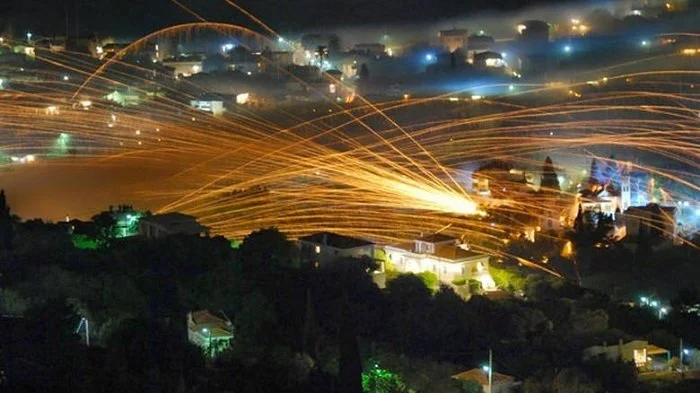
Before 1889, real cannons would be used to fire at each congregation, but now it’s just fireworks and ugly comments about lamb being overcooked.
Georgia (Europe)
When I studied wine, it was said that Georgia may have been one of the first places to produce fermented products that we call wine today.
Estimates are that they were at it at least 6,000 years ago.
That’s a hell of a vintage!
Today, there’s a unique tradition of celebrating Easter in graveyards.
People gather in cemeteries to visit the graves of loved ones and to honour their contributions to the success of the family today.
The tradition likely gained traction during Soviet rule from 1921 to 1991, when the regime persecuted the public practice of Orthodox Christianity. As many churches shuttered, traditions that typically took place in houses of worship found a new stage—including honoring the dead each Easter. – BBC
Rituals of Georgian Easter cemetery visits include:
- When: Primarily on Easter Monday, although many visit on Sunday or throughout the week.
- The Feast (Supra): Families clean gravesites and set up tables, often built directly over or beside the burial plots. They share a meal that includes grilled meats, cheese bread (khachapuri), wine, and chacha.
- Symbolism of Red Eggs: Eggs are dyed dark red, typically using madder roots or onion skins, to represent the blood of Christ.
- Rituals:
- Rolling Eggs: Red eggs are rolled across the graves to symbolize Christ’s victory over death.
- “Knocking Over a Goblet”: Wine is poured onto the graves as a toast to the deceased.
- “Christ is Rising”: Visitors proclaim this phrase three times to the deceased.
- Atmosphere: It is rarely a somber event, but rather a lively reunion of families (living and deceased).
- Origins: The custom was intensified during the Soviet era when churches were closed, leading families to use graveyards for worship and communal gathering.
North America
Okay … so let’s try to move beyond the Caucasian influence.
Do North American Indigenous People celebrate aspects of spring returning?
Of course they do.
Most of the documented ceremonies and rituals that I found revolve around things like maple syrup and the running of the sap.
There are themes of economic and spiritual renewal associated with this event, as it signifies their collective ability to survive after winter. The take on the stories tend to focus on the work that’s still required to produce syrup from sap, something that all of us should appreciate.
For the Hopi, spring is when Katsinam (spirit beings) return to the villages. Katsina dances begin in winter and continue into spring, bringing rain, fertility and balance to the world.
These beings act as messengers between humans and the spirit world. Their departure in midsummer marks the end of this seasonal spiritual presence.
Among the Mi’kmaq in eastern Canada, spring marks the return of birds and the reopening of waterways. Stories of Glooscap often explain landscape changes and seasonal shifts and the spring marks a time for fishing, gathering, and renewing kinship ties. Oral traditions focus on how the land is “waking up.”
The shared themes often involve tales and myths about the Trickster and transformation, reciprocity, and spiritual renewal.
By the way, today (March 31) is National Indigenous Languages Day.
Here’s a message from Canada’s Governor General Mary Simon:
Language is more than simply a means of communicating. It plays an essential role in carrying the culture, spirit and wisdom of a people from one generation to the next.
That is why I am so pleased to see Indigenous languages being revitalized and passed down to youth across Canada. Not only through oral tradition, but also through new networks and technologies that help circulate that knowledge. By embracing their identities and speaking their ancestral languages with pride and determination, Indigenous peoples are building a future where this precious heritage can thrive.
This National Indigenous Languages Day, all Canadians are encouraged to celebrate and honour the rich tapestry of oral traditions, storytelling and songs interwoven in the complex history of our nation.
India – Holi
Holi translates roughly to ‘grain’, specifically roasting parched grain.
Holi is celebrated at the end of winter, on the last full moon day of the Hindu luni-solar calendar month, marking the spring, making the date vary with the lunar cycle. The date falls typically in March (this year it was March 3, 2026), but sometimes in late February of the Gregorian calendar.
Think COLOUR. Vibrant pastels of yellow, orange, blue, purple and red. Everywhere!
This ceremonial roasting is not merely a folk tradition but is codified in the Gṛhyasūtras (ancient instructional sources). These records date the practice to between 750 BCE and 400 BCE, providing a historical witness for a celebration that has likely existed for even longer. Hindus have been celebrating Holī for over 2,500 years.
Depending on regional traditions and where you are in the world, Holi can be a multi-day festival or an afternoon celebration. The first evening iis known as Holi Purnima (the Holi full moon) and usually involves a bonfire as people gather around to sing and dance in hopes of overcoming negativity by getting rid of unsatisfactory thoughts and deeds from the previous year. On the next day, people of all ages wear white to throw colored powder (gulal) or colored water (pani) at one another. In the evening, everyone gets together with their family and friends to enjoy festive foods, sweets, and companionship. Hindu temples are decorated with bright colors and the deities are decorated with glittering jewels and clothing. With a theme of harmony and new beginnings, Holi encourages people to renew our efforts at becoming decent human beings—reflect on our past misdeeds, improve our routines and interactions, and continue making progress in life.
The myths run deep with Holi.
One famous tale revolves around the legend of an arrogant and powerful demon king, Hiranyakashipu, and his son Prahlad, who defied his father’s wishes by worshipping the deity Vishnu. In a bid to kill Prahlad, Hiranyakashipu conspired with his sister, Holika, to burn him alive. Through divine intervention, Prahlad was unharmed, while Holika perished in the flames. The legend symbolizes the victory of good over evil, a theme central to Holi celebrations.
Also connected to Holi festivities is the love story of Radha and Krishna. According to Hindu mythology, the deity Krishna, whose skin was turned blue by a demon, was enamored by Radha, the epitome of love and devotion.
For more about Holi, visit this site.
Japan – Cherry Tree Festival
I’ve only read a bit about the Japanese Cherry Tree Blossom Festival that has taken place for centuries.
What struck me is the Japanese relationship with nature. While most Western cultures celebrate deification and legends concerning life and death, the Japanese place seem to place reverence for nature above all else.
People gather under blooming trees and reflect on impermanence (mono no aware). They celebrate life’s brief but beautiful cycles.
Here’s a haiku about the blossoms:
Pink petals dancing,
Soft blankets fall on the grass,
Spring joy fills the air.
Or this one from Kobayashi Issa, considered a great master of haiku:
kimi nakute / makoto ni tada no / sakura kana
without you–
the cherry blossoms
just blossoms
China
China is know for the Qingming Festival in the spring and it normally occurs early in April. It’s also known as ‘Tomb Sweeping Day’.
Traditions include families gathering to honour ancestors while enjoying spring outings. They clean graves to symbolize a connection with their past but to also express renewal.
Like Japan, the Qingming Festival demonstrates a reverence for nature and its relationship with remembrance.
More bout Qingming can be found here.
Research / Sources / Other Spring Equinox Observances
- https://www.youtube.com/watch?v=tgXshI6hheo
- https://www.countryliving.com/uk/travel-ideas/abroad/a60172393/spring-equinox-traditions/
- https://wemoon.ws/blogs/pagan-holiday-traditions/spring-equinox
- https://en.wikipedia.org/wiki/March_equinox.
- https://www.beceremonial.com/blog/rituals-for-the-spring-equinox/
- https://www.accuweather.com/en/travel/first-day-of-spring-celebrations-around-the-world/695364
- https://www.msn.com/en-us/travel/tripideas/12-spring-celebrations-around-the-world/
- https://ssec.si.edu/stemvisions-blog/what-is-the-spring-equinox
- https://www.bbc.com/news/uk-england-wiltshire-65023795
- https://www.odysseys-unlimited.com/10-springtime-celebrations-from-around-the-world/
- https://www.stmweather.com/blog/meteorology-101/counting-down-to-the-spring-vernal-equinox
- https://hilltownfamilies.org/2024/03/18/cultural-studies-holi/?v=a672068055fa
- https://nsa-erasmus.com/en/the-bulgarians/