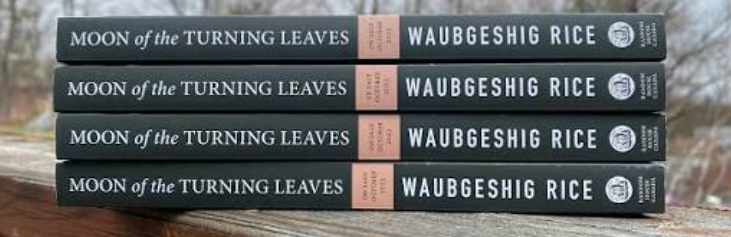
Moon of the Turning Leaves by Waubgeshig Rice (Penguin, 2023, 305 pages) is a sequel to his first book, Moon of the Crusted Snow (ECW, 2018, 224 pages). The stories revolve around Evan Whitesky and his family as they adapt to a cataclysmic event that leaves the world without electricity. Turning Leaves picks up twelve years after Crusted Snow ends, with Evan and a small group leaving their family to find more resources and other similar communities.
These works are frequently cited as part of the growing canon of ‘Indigenous Futurisms’, a genre that describes ‘a thought experiment placing Indigenous people in a future setting’ (Dillon). However, after speaking with Mr. Rice (August, 2026)*, he clarified that he prefers the term Wonderworks. This genre describes ‘other worlds existing alongside colonist realities that reflect Indigenous values and engagements that are routinely dismissed by colonial authorities’ (Justice). Examples would include the use of non-European language and rituals that are commonly ignored or misrepresented in mainstream literature.
Rice indicated that the 2003 blackout was the inspiration for his work. As a journalist with the CBC in Toronto, he witnessed the contrast between the material world of people in bigger cities versus his community. In the aftermath of the blackout, he added layers to his writing based on his knowledge and stories shared with his grandmother and other elders about the multigenerational challenges associated with residential schools, Missing and Murdered Indigenous Women and Girls (MMIWG), and inadequate living conditions on reservations.
Given this framework, Rice’s fiction is an extension of real life experience. It depicts a group in the aftermath of an apocalypse, successful because of their sense of community and connection with traditional activities such as hunting, fishing, storage and preservation of food.
On their journey south, the group comes across The Disciples (Caucasians who resemble the Michigan Militia) and engage in a skirmish where Evan is wounded. He eventually succumbs to his injuries, but not before witnessing his daughter Nangohns build on her traditional Anishinaabemowin skills such as archery, tracking and hunting. He also gets to discover a new community called Saswin (‘the nest’). What makes Turning Leaves a beautiful story is that despite encountering dangerous thugs, there’s no larger dark element, no surprises (Guynes). Just a community that embraces the travelers.
Rice describes the epilogue as his favourite bit of writing (Rice), where the group is much larger and self-sufficient. He projects a joyful future for his community, where grandchildren (including Waawaaskone, Evan’s granddaughter) live successfully in their new environment, speaking Anishinaabemowin, embracing their traditions.
Ecopia (my sequel-in-progress for Extinction Event) is modestly similar to Turning Leaves, in that a ‘new world’ of existence follows a massive disruption to humanity around the world. However, they differ in that Rice’s story is propelled by scarcity and adherence to tradition; mine is propelled by abundance and people trying to find a sense of purpose in a world where they can have whatever they want. Where the two cross paths again is when people realize that they need others to survive.
With Turning Leaves, Rice uses a number of writing craft techniques to his advantage, including setting, language and shifting narrative.
The setting of Turning Leaves is the wilderness around them. Rice does an exceptional job of making the forest an important ‘character’ (Keogh), with human-influenced structures fading and falling apart while natural elements thrive. Characters’ decisions are influenced by their surroundings, with some resulting in disaster (eg. when J.C. slips and breaks an ankle).
My goal is to generate similar contrasts in Ecopia, where people who leave the Nova Doma community encounter purpose-built archeological elements, crumbling ‘modern’ infrastructure and nature reclaiming everything. Furthermore, Ecopia reveals that many communities were spared from the wrath of DUAL (the Day of Universal Animal Liberation) because they exist in harmony with their environment.
Rice makes full use of Anishinaabemowin language and culture. Most characters and places carry pre-colonist labels. In the epilogue, all dialogue is Anishinaabemowin, except the last line. I admire this and with Ecopia, I endeavour to use indigenous place names. For example, the Amazon is either ‘Amaru Mayu’, a common Quechua term meaning ‘serpent river’, or ‘Paraná-tinga’ in the Tupi-Guarani language (Paraná = ‘great river’, tinga = white). I might be called out for either being revisionist or incorrect (or both), but I’m willing to take the risk.
The narrative is driven by a close third-person limited perspective that shifts over the course of the story. It begins with Evan’s perspective, but towards the middle, moves to Nangohns and eventually to his granddaughter (Nangohns’ niece) Waawaaskone**. Rice uses POV to move the spotlight to the next generation (Rice), connecting the reader with the future of their community.
The narrative pace isn’t loaded with clichés or action sequences that are routinely tossed at Western audiences. I believe this approach is necessary in order to restructure the narrative into something more familiar to the Wonderworks genre. Rice’s work is driven by the group’s adaptation to the environment as opposed to continuous wild skirmishes with other people or things. My project reflects similar sentiments: tension is less about external conflicts and more challenges that derive from the natural environment.
Moon of the Turning Leaves represents a new approach to post-apocalyptic visions in fiction. It demonstrates the need for an elastic relationship with time and traditions. The further we pull away from our past and traditions that keep us grounded, the more tension we get. Rice uses a cataclysmic event to create a seamless bridge between the past and the future. I hope to do the same with characters and situations in Ecopia, where The Remainders learn valuable life lessons from other cultures that live in harmony with nature.
On a personal note, I might say I envy Rice for being at the top of the wave of a new literary (Wonderworks or Indigenous Futurisms), but I have to remind myself that it can be argued that his experience with real-life dystopia comes as a result of the utopia or privilege that a colonist such as myself enjoys. In other words, I need to be careful what I wish for. It can also be said (with no personal experience, I admit) that this cataclysm works to accelerate the return of traditional capabilities and heritage of Waub’s Indigenous characters, resulting in a strong emotional feeling of reclaiming what was lost due to colonial intrusions.
* Yes – I did reach out to Waub and he graciously accepted my request to speak with him about his books. We spent about an hour exploring the inspiration, themes, language and other craft elements he uses. We also discussed a few non-essay topics. His response was a wonderful and kind gesture, making this grumpy old man feel like an adoring author and kid. Chi Miigwech!!
** For clarification, Waawaaskone is the daughter of Evan’s son Ma’iingan and his partner Pichu, with Nangohns being the aunt.